

By Melzware — 12 October 2026 · 8 min read
The best cereal dispenser for pantry shelves is a tall, slim, airtight container with a flip-top pour lid. It holds a whole box, stands upright, and lets a child pour without opening the main seal. Twist dispensers suit countertops and small, hard cereals like loops and puffs. Whichever type you choose, check the seal first. That is what keeps cereal crisp, not the pouring mechanism.
Shop Cereal Containers at Melzware
The four types of cereal dispenser
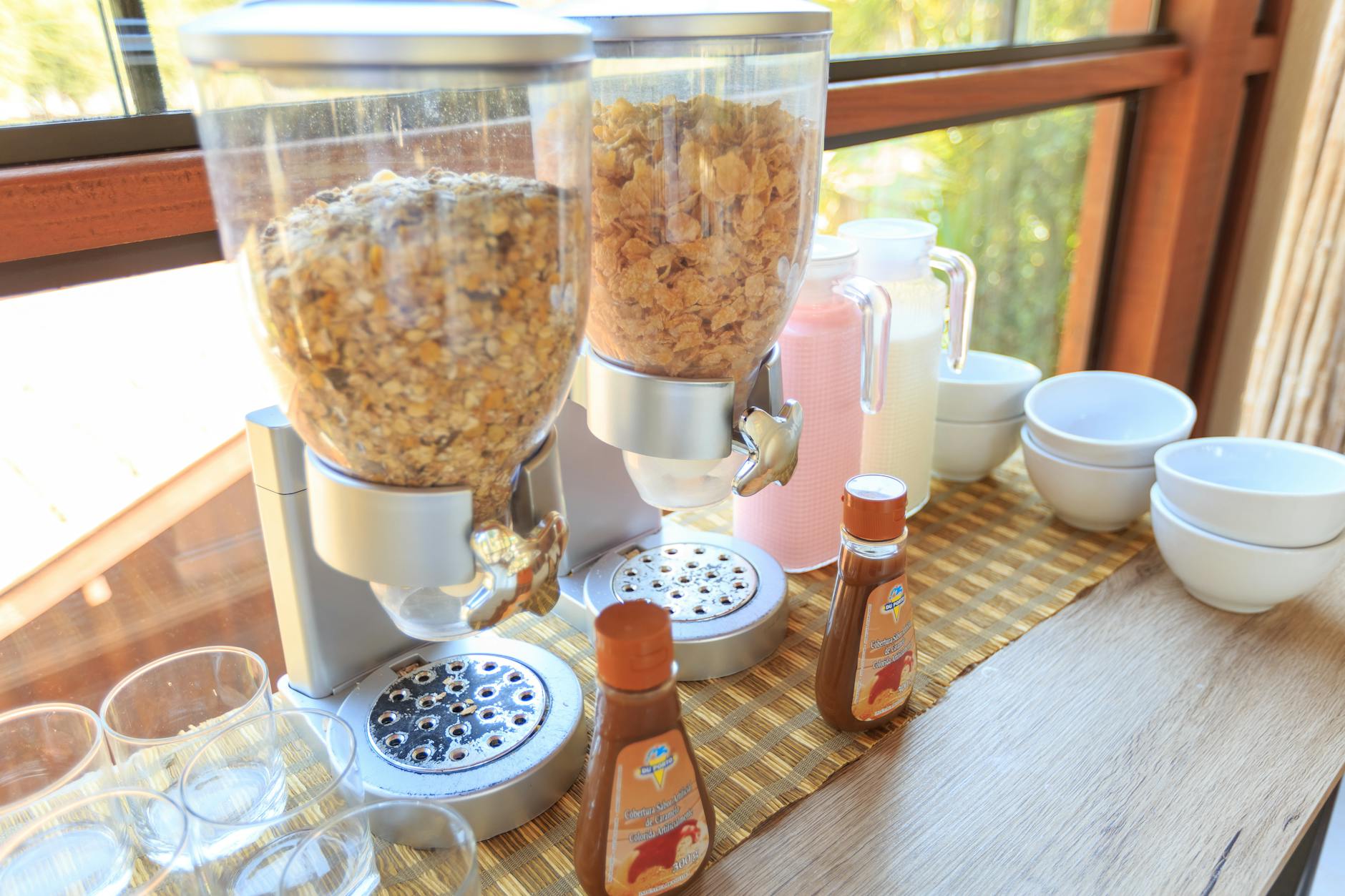
"Cereal dispenser" covers four quite different products. Know which one you are looking at before you compare prices.
1. Flip-top container
A tall, slim, rectangular tub with a locking lid. A small flap in the lid flips open to pour. This is the pantry workhorse. It stands on a shelf like a cereal box, and the flap means you never break the main seal to serve.
2. Countertop cereal dispenser (twist or gravity)
A clear cylinder on a stand. Turn a knob and a rubber paddle wheel drops a portion into the bowl below. These are what you see at hotel breakfast buffets. They look good on a counter and give even portions, but they take up a lot of space and suit only some cereals.
3. Pitcher-style canister
A jug shape with a handle and a hinged spout. It pours like a milk jug. It is easy for small hands, but the round shape wastes shelf space.
4. Wall-mounted dry food dispenser
A twist or lever dispenser fixed to a wall or the inside of a cupboard door. It frees up shelf and counter space. It also means drilling, and you can only fill it from the top while it hangs.
Cereal dispenser vs container: which to buy
| Flip-top container | Twist dispenser | |
|---|---|---|
| Best spot | Pantry shelf or cupboard | Countertop or wall |
| Cereal types | All, including flakes and muesli | Small, hard shapes only |
| Portions | You pour what you want | Fixed amount per turn |
| Refilling | Open the lid and tip in a box | Remove the top cap and pour carefully |
| Cleaning | Often dishwasher safe | Usually hand wash, several parts |
| Stackable | Side by side, yes | No |
Straight up: for most South African kitchens, the flip-top container is the better buy. A twist dispenser only makes sense when you have spare counter space and your family eats small, hard cereal. One popular twist model releases about 28 g per turn. A typical bowl needs 30 to 45 g, so most mornings involve two turns and a pile of crumbs in the catch tray. A flip-top lets you pour the right amount once.
The twist dispenser wins in one place: portion control for kids. If the cereal box empties in three days because someone keeps topping up their bowl, fixed portions help.
How to choose the best cereal dispenser

The seal
Look for a silicone gasket in the main lid and clips that lock it down. Cereal goes stale by taking on moisture from the air. In a humid Durban kitchen, an open box can go soft in days. If the main lid just rests on top, the container is a bowl with a cover, not an airtight store.
Capacity
A standard box of cereal needs about 4 litres. Large family boxes, bulk muesli and puffed rice need 5 to 6.5 litres. Buy one size bigger than you think. A container that can't take the whole box leaves you with a half-box going stale next to it.
Opening size
Check two openings. The pour flap must be wide enough for your cereal's biggest piece, or clusters jam. The main lid must be wide enough to tip a box into without spilling.
Material
Clear BPA-free plastic is the usual choice. It is light, shatterproof when a child drops it, and lets you see when stock runs low. Glass looks good on a counter but gets heavy and breakable at 4 litres and up.
Shape and footprint
Rectangular beats round in a pantry. Square edges sit flush against each other, so four rectangular containers take less shelf than three round ones.
Cleaning
Fewer parts means easier cleaning. A flip-top has a body, a lid and a gasket. A twist dispenser has a cylinder, a cap, a paddle wheel, a stand and a catch tray. Check whether each part can go in the dishwasher.
Our Airtight Cereal Containers (R549 for four) are the flip-top type: two 6.3 litre and two 4 litre containers, with locking lids, BPA-free plastic, and dishwasher-safe parts.
Which cereals suit which dispenser
Most buying guides skip this, and it is the main reason people return twist dispensers.
| Cereal | Flip-top container | Twist dispenser |
|---|---|---|
| Loops, puffs, rice cereal | Yes | Yes, pours cleanly |
| Cornflakes and bran flakes | Yes | No, the paddle crushes them |
| Muesli and granola with clusters | Yes | No, clusters jam the wheel |
| Wheat biscuits (Weet-Bix style) | Yes, stacked on their side | No |
| Oats | Yes | Works, but fine dust collects in the tray |
If your household eats a mix, the flip-top container handles everything. A twist dispenser handles roughly half the cereal aisle.
Sizing a cereal dispenser for pantry shelves

Measure before you buy. It takes two minutes and saves a return.
- Shelf height. Measure from the shelf to the one above. Add 5 cm to the container height, because the flip-top needs room to open while the container stands on the shelf.
- Shelf depth. A slim container turned sideways can sit two deep on a deep shelf. Put the cereal you eat most at the front.
- Box volume. Hold your usual box next to the container. If the box is taller or wider than the container, the cereal won't all fit.
- Counter space (twist types). Leave room for a bowl under the spout and for your hand to turn the knob.
Store the containers away from heat. Ohio State University Extension notes that cupboards above the stove, next to the dishwasher or beside the fridge exhaust run warm, and warm cereal goes stale faster. For a full pantry layout, see our guide to kitchen storage containers and pantry organisation.
Setting up, refilling and cleaning

- Refill over the sink. Crumbs go down the drain, not across the floor.
- Empty before you refill. Don't pour a new box on top of old cereal. The stale bit at the bottom never gets eaten, and any pantry moths come along with it.
- Cut out the date. Snip the best-before date and the nutrition panel off the box and tape them to the back of the container. Opened cereal keeps 2 to 3 months, according to Ohio State University Extension.
- Wash between boxes. Warm soapy water or the dishwasher, then let the container dry fully. A damp container makes fresh cereal soft within a day.
- Check the gasket. Pull it out every few washes, rinse the groove, and push it back in flat. A twisted gasket lets air in.
- Use the spares. A flip-top cereal container works just as well for rice, pasta, dog biscuits and snacks. Our pantry food storage container guide covers what each staple needs.
When you don't need a cereal dispenser
Heads up: not every kitchen needs one. Skip it if any of these apply.
- A box lasts less than a week in your house. Cereal won't go stale in that time. Fold the liner down tightly, clip it, and save the money.
- You buy a different cereal every week and like the variety. You'll spend more time washing containers than eating from them.
- Your pantry is already full and you have no counter space. A dispenser adds a container. It doesn't free up room unless it replaces several half-empty boxes.
- You only eat large flakes or muesli and want a countertop twist dispenser. It will crush or jam. Buy a flip-top container or nothing.
If you have two or more cereals open, a box that goes soft before it's finished, or kids who pour their own breakfast, a set of flip-top containers pays for itself in cereal you stop throwing away. It also ends the half-eaten box with its liner rolled shut like a sleeping bag. For more on keeping cereal crisp, read our cereal storage containers guide.
Frequently asked questions
How many cereal dispensers should I buy?
One per cereal you keep open at the same time, plus one spare. Most families have two to four boxes on the go, so a set of four covers it. The spare takes the next box while you wash an empty one.
What is the best cereal dispenser if lids are hard to open?
A flip-top container. The small pour flap opens with one thumb, and you never need to twist or unclip the main lid to serve. Twist dispensers also work without grip strength, but they are harder to refill and clean.
Can I store other food in a cereal dispenser?
Yes. Flip-top containers work for rice, pasta, oats, sugar, nuts and dog biscuits. Twist dispensers suit anything small and free-flowing, like rice, lentils, nuts and sweets. Avoid flour in either, because it clogs the pour opening.
How long does cereal stay fresh in a dispenser?
Ohio State University Extension gives opened ready-to-eat cereal 2 to 3 months at about 21 degrees Celsius. An airtight dispenser helps cereal reach that time. A dispenser with a loose lid or an open chute will not.
Do twist cereal dispensers crush cereal?
They can. The paddle wheel breaks large, fragile flakes and clusters, which leaves crumbs at the bottom. Small, hard shapes like loops, puffs and rice cereal pass through cleanly. Keep cornflakes and muesli with big clusters in a flip-top container instead.
Are cereal dispensers dishwasher safe?
Many plastic flip-top containers are, including ours. Most twist dispensers are not, because the paddle and seals warp in hot water. Check the label, and always let a container dry completely before refilling it.
Related at Melzware
- Shop cereal containers
- Shop pantry organisers
- Cereal storage containers: how to keep cereal crunchy
- Pantry food storage container guide